
· by Michael Blair, Nashville's Flooring
Engineered hardwood has real wood on top, so it looks like a floor that can be sanded and refinished like any other. Some can and some cannot, and the difference does not show from the top of the board. It comes down to how thick that top layer of wood is, what kind of finish went on it, and what the maker says about its own product. This is how we sort it out before a sander goes anywhere near an engineered floor on a refinishing job.
How thick does the top layer of an engineered floor have to be?
At least 3/32 of an inch, about 2.5 millimeters, of real wood before the floor should be sanded at all, under the National Wood Flooring Association’s general guidance. The NWFA’s article launching its Engineered Wood Flooring Refinishable Program, in Hardwood Floors magazine, quotes its sand-and-finish guidelines: in general, a floor with a wear layer under 3/32 inch should not be sanded.
The program builds its minimums on that line. To carry the refinishable mark, a smooth factory-finished floor needs a wear layer of 2.5 mm (3/32 inch), a sculpted or distressed floor needs 2.5 mm at its lowest point, and a smooth unfinished floor needs 3.2 mm (4/32 inch). The unfinished floor gets the extra 1/32 because it is sanded and finished once on site when it goes in. The article’s reasoning is that a careful sanding should take off less than about 1/32 inch, so a 4/32 floor finished on site is left with roughly the 3/32 a factory-finished floor starts with.
The number is not only an American one. The same article notes that in Europe a product can only be called parquet if its real wood top layer is at least 2.5 mm thick, a rule set by the European Federation of the Parquet Industry, and that NWFA lined its benchmark up with it.
Can pre-finished flooring be sanded?
Sometimes, and the maker’s word on its own product settles it before the thickness does. Shaw answers in its hardwood planning and installation FAQ that its hardwood flooring cannot be refinished, because the factory finish is hard enough to wear out most sanding equipment. Mannington, which says it makes only engineered hardwood, writes in its guide to hardwood flooring that some hardwood floors can be sanded and refinished multiple times.
Two makers of real-wood floors give opposite answers about their own products, which is why we look up the specific product line before we quote. The NWFA’s program does not settle it for every floor either, because it is voluntary. NWFA’s 2023 announcement on the program put the number of participating companies at 23 after AHF Products, Mirage, Vintage Hardwood Flooring and Preverco joined, the newest count we found. A floor without the mark is not necessarily too thin to sand; its maker may simply never have applied.
How we check a floor that is already down
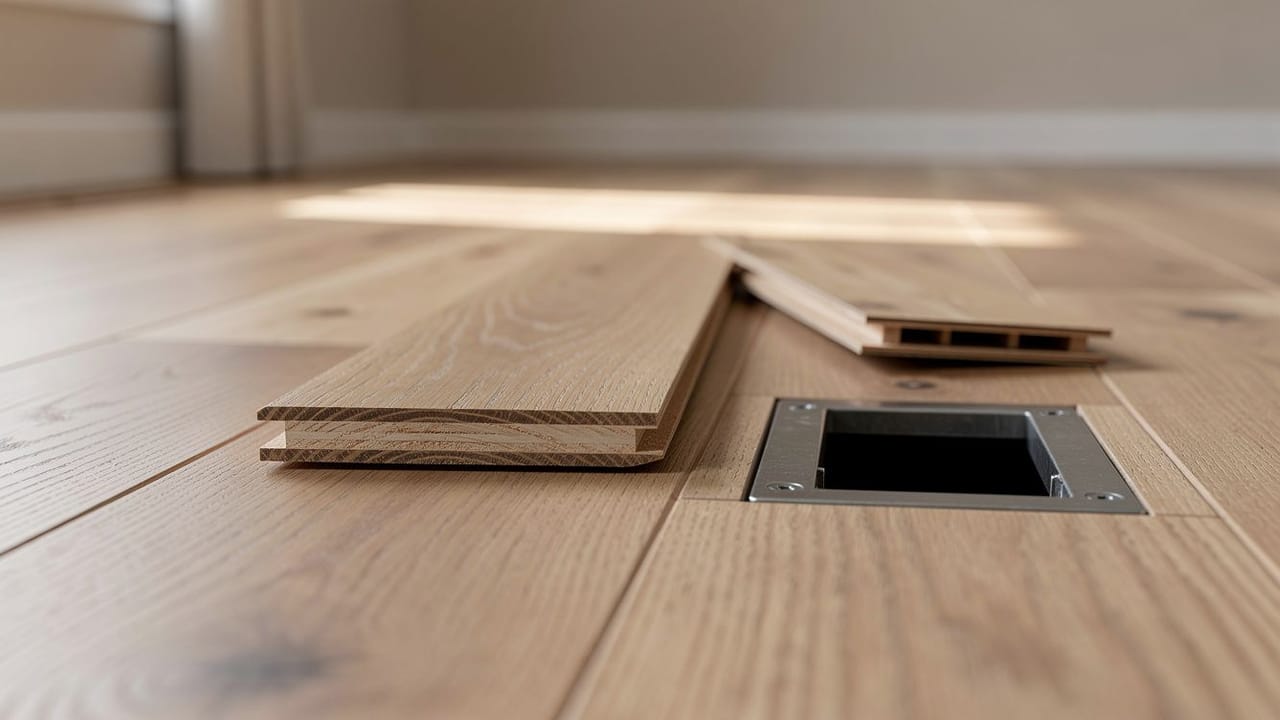
We find out what the floor is, then look at what is left of the top layer. The quickest route to the product is paper: a receipt, a leftover box in the garage, or the builder’s selection sheet that names the maker and the line, so the maker’s own data can be read. Without that, lifting a floor register or pulling a threshold usually shows the cut edge of a board, where the wear layer is the band of solid wood above the core.
Hand-scraped and sculpted floors take extra care. The NWFA article points out that on those floors the wear layer may be thinner than 3/32 inch in many places, and the low spots decide how far the whole floor would have to be sanded to come out flat.
For a solid hardwood floor the decision is a different one, and our post on whether to refinish or replace hardwood covers it.
What can you do when an engineered floor is too thin to sand?
Recoat it without sanding to bare wood, repair the damaged boards, or replace the floor. Mannington describes screen and recoat as the alternative to refinishing when you do not want to change the color: it refreshes the coating and restores the floor’s luster. It suits a floor that is dull and scuffed in the finish but not worn through it. Because it stops short of bare wood, it cannot change the stain color, and whether a particular factory finish will take a recoat is a question for its maker.
Where the trouble is a few boards rather than the whole room, replacing those boards can be the better repair, and our post on hardwood repairs that do not mean refinishing every room covers how that works. If you are not sure what is in your house, send us a photo of the floor and anything you have on the product and we will tell you which of these is realistic for a home in Nashville or nearby.
Sources
- National Wood Flooring Association, NWFA Launches Engineered Wood Flooring Refinishable Program (Hardwood Floors, Aug/Sept 2022) — Wear-layer minimums of 3.2 mm (4/32 in) unfinished and 2.5 mm (3/32 in) factory-finished and sculpted; no sanding under 3/32 in; under 1/32 in removed per sanding; FEP 2.5 mm parquet rule; voluntary program
- National Wood Flooring Association, Leading Wood Flooring Manufacturers Embrace NWFA Engineered Refinishable Program (2023) — Four companies joined, bringing participants to 23; the program is voluntary
- Shaw Floors, Hardwood: plan and install FAQ — Shaw says its hardwood flooring cannot be refinished because the factory finish would wear out sanding equipment
- Mannington, Ultimate Guide to Hardwood Flooring (2019) — Some hardwood floors can be sanded and refinished multiple times; screen and recoat when the color stays; Mannington makes only engineered hardwood
FAQ
Can Engineered Hardwood Be Refinished? — questions
Can engineered hardwood floors be refinished?
Some can. The NWFA’s general guidance is that a floor with less than 3/32 inch of real wood on top should not be sanded, and some makers rule out sanding their own products whatever the thickness. A floor with a thick enough wear layer, from a maker that allows it, can be sanded and refinished like solid wood.
Can prefinished hardwood floors be refinished?
It depends on the product. Shaw says its hardwood flooring cannot be refinished because the factory finish is hard enough to wear out most sanding equipment, while Mannington says some hardwood floors can be sanded and refinished multiple times. Look up the specific maker and product line before anyone brings in a sander.
How many times can engineered hardwood be sanded?
No source we rely on gives a count. The NWFA sets thickness thresholds instead: under 3/32 inch of wear layer, a floor generally should not be sanded, and a careful sanding takes off less than about 1/32 inch. How many sandings a floor has left depends on what is still on top and on its maker.
How thick does an engineered wood wear layer need to be to refinish?
At least 3/32 inch, about 2.5 mm, under the NWFA’s general sanding guidance and its refinishable program for factory-finished floors. Floors that arrive unfinished and are sanded on site need 4/32 inch, about 3.2 mm, to qualify, so that the first on-site sanding still leaves roughly 3/32 inch of wood.
How can you tell if engineered flooring can be refinished?
Find the maker and product line, from a receipt, a leftover box or the builder’s paperwork, and read what that maker says. Then look at the wear layer on a cut edge under a register or at a threshold. The NWFA’s refinishable mark identifies certified products, but the program is voluntary.
Can engineered hardwood be screened and recoated?
Often, when the wear is in the finish rather than the wood. Mannington describes screen and recoat as a way to refresh the coating and restore the luster without changing the color. It does not sand down to bare wood, so it cannot change the stain, and whether a factory finish accepts a recoat is up to its maker.