
· by Michael Blair, Nashville's Flooring
Solid hardwood takes on moisture in a humid Nashville summer and gives it back once the furnace is running, and it changes width as it does. The USDA Forest Service’s Wood Handbook chapter on drying and moisture control describes the pattern directly: cracks develop in wood flooring that takes up moisture and then shrinks when the building is heated. Gaps that open through the heating season and narrow again in the humid months are the floor behaving the way wood behaves. When we look at a hardwood floor in winter, the first job is telling that seasonal movement apart from something that needs fixing.
What do normal winter gaps look like?
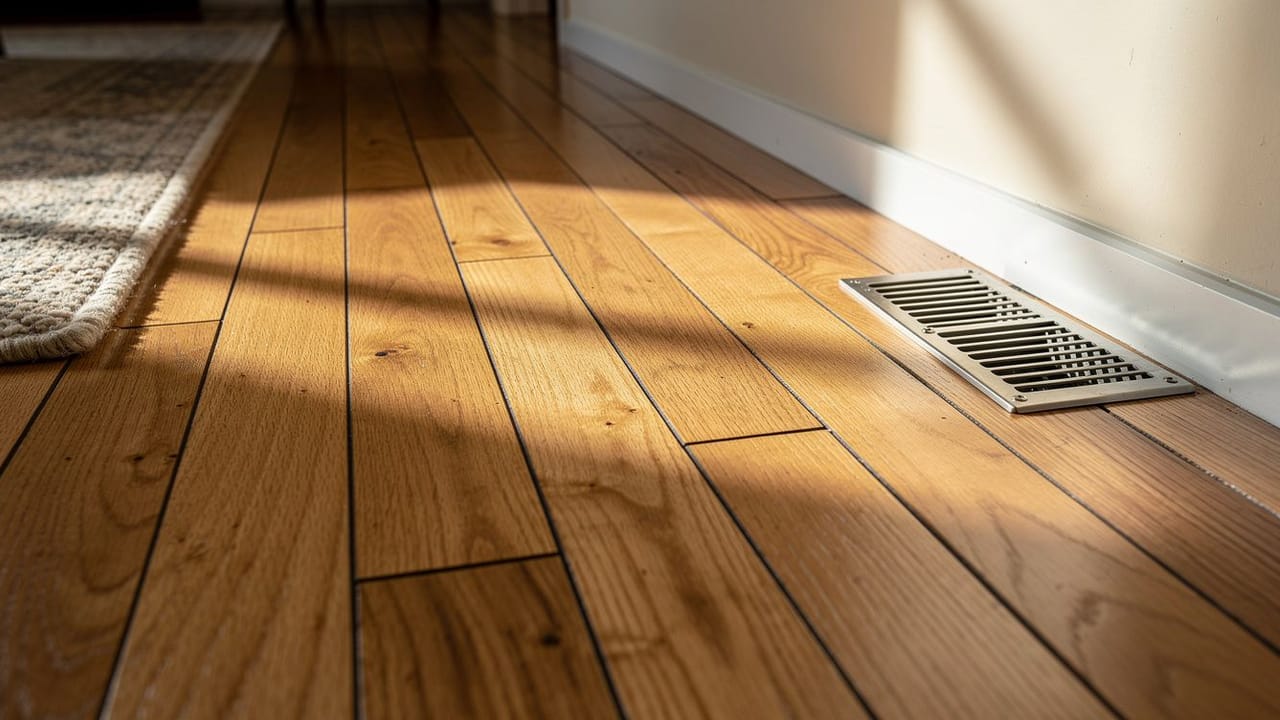
Thin, even gaps distributed across the floor, appearing in winter and closing in summer. Wide planks show them more, and the handbook’s arithmetic explains why: it estimates a board’s change in width by multiplying its starting width by a shrinkage coefficient and by the change in moisture content, so a plank twice as wide moves about twice as far for the same drop in moisture.
A good finish does not stop any of this. The handbook’s chapter on moisture relations says coatings such as varnish, lacquer or paint slow moisture changes in wood without preventing them, and that wood shrinks most in the direction of its growth rings and about half as much across them. A sealed floor still breathes with the seasons, and the way each board was sawn decides part of how much.
Which floor gaps are not normal?
Gaps that stay open all year, gaps concentrated in one area rather than spread evenly, cupping where board edges rise above the center, or crowning where the center rises above the edges.
We treat any of those as a reason to look for a moisture source before blaming the season: a damp crawl space, a plumbing leak, or a slab that was not tested before the floor went down. Water from below does real damage. EPA’s moisture control guidance for buildings shows a hardwood gymnasium floor warped by moisture rising through the concrete under it, and the same document lists a water vapor emission test for concrete slabs (ASTM F1869 or F2170) before flooring is installed. Our post on putting flooring over a Nashville concrete slab goes through those tests, and no cupped or crowned floor goes to refinishing with us until its moisture readings are back where they should be.
- Even seasonal gaps: normal
- Gaps that never close: we look for a moisture or installation problem
- Cupping: we check below the floor for a moisture source first
- Crowning: we take moisture readings before any sanding is discussed
- Localized gapping: we look for a leak nearby
The crawl space connection
A lot of the houses we work in around Middle Tennessee sit over a crawl space, and what happens down there reaches the boards above. EPA’s guidance says that in low-rise buildings, damp basements or crawl spaces may add as much water vapor to the air in a day as all the other indoor sources combined.
The same document says crawl spaces may be vented to the outdoors or air sealed, describes a plastic or elastomeric membrane over the soil to stop evaporation into a sealed one, and in its construction guidance calls for keeping crawl space humidity below 65 percent, with dehumidifiers where needed. When a floor over a crawl space cups or gaps unevenly, we look underneath before we touch the boards, and any damaged framing or sheathing goes to subfloor repair first. Our post on what to check before hardwood floors go down covers the crawl space conditions one manufacturer asks for.
Managing indoor humidity
EPA’s brief guide to mold, moisture and your home recommends keeping indoor relative humidity below 60 percent, ideally between 30 and 50 percent. That advice is written for mold and comfort rather than floors, and the instructions for your particular flooring set the range its warranty holds you to. A humidity meter, which the same guide says costs $10 to $50 at many hardware stores, shows where your house actually sits in each season.
Summer is the easier half: EPA says to use air conditioners or dehumidifiers when needed. Winter takes more care. The Wood Handbook ties wood’s moisture content to the relative humidity and temperature of the air around it, so adding some humidity in winter brings the boards closer to their summer size. But the handbook’s chapter on wood in buildings lists humidifiers among the indoor moisture sources to limit in heating climates, because moist indoor air working into the walls causes its own problems, and EPA notes that condensation on windows can be a sign of high humidity. If the windows fog, turn the humidifier down. If your gaps are still open in August, or the boards have started to cup, ask us for a free estimate and we will take readings before recommending anything.
Sources
- USDA Forest Service, Forest Products Laboratory, Wood Handbook, chapter 13: Drying and Control of Moisture Content and Dimensional Changes (FPL-GTR-282) — Cracks in wood flooring that takes up moisture and shrinks when the building is heated; change in width estimated from starting width, coefficient and moisture change.
- USDA Forest Service, Forest Products Laboratory, Wood Handbook, chapter 4: Moisture Relations and Physical Properties of Wood (FPL-GTR-282) — Wood moisture content follows relative humidity; coatings slow but do not prevent moisture change; tangential shrinkage about twice radial; gaps in flooring.
- U.S. EPA, Moisture Control Guidance for Building Design, Construction and Maintenance (EPA 402-F-13-053) — Hardwood floor warped by moisture through the slab; slab vapor emission test before flooring (ASTM F1869, F2170); crawl spaces as a moisture source; vented or air-sealed crawl spaces, soil membrane, crawl space humidity below 65 percent.
- U.S. EPA, A Brief Guide to Mold, Moisture and Your Home — Indoor humidity below 60 percent, ideally 30 to 50; $10 to $50 humidity meter; air conditioners or dehumidifiers; condensation as a sign of high humidity.
- USDA Forest Service, Forest Products Laboratory, Wood Handbook, chapter 17: Use of Wood in Buildings and Bridges (FPL-GTR-282) — Humidifiers listed among indoor moisture sources to limit in heating climates.
- USDA Forest Service, Forest Products Laboratory, Wood Handbook, chapter 11: Wood-Based Composite Materials (FPL-GTR-282) — Plywood’s cross-laid layers give excellent dimensional stability along its length and across its width (FAQ on engineered wood).
FAQ
Why Hardwood Floors Gap Every Winter — questions
Should I fill gaps in a hardwood floor?
We do not fill seasonal ones. They are expected to narrow on their own as the boards take moisture back on in the humid months, so we would rather watch a floor through a full year before calling a gap permanent. Gaps that stay open year-round are a different case: we find and correct the moisture cause first, and only then talk about repairing them during a refinish.
Is engineered wood better in Nashville humidity?
It is built to move less. Engineered flooring is made in layers, and the Wood Handbook’s chapter on wood-based composites explains for plywood that layers laid with their grain at right angles to each other give excellent dimensional stability along the length and across the width. Whether a particular product suits a crawl space or a slab, and how many times its wear layer can be sanded, depends on that product, so we read the manufacturer’s instructions for the one you are considering.
Will a humidifier stop my floor gapping?
It can reduce it, but it will not stop it. Gapping follows the difference between the wood’s moisture content in summer and in winter, so raising winter humidity toward the middle of the comfortable range narrows that difference. Some movement is inherent to solid wood, and a finish only slows it. Watch the windows as you go: EPA treats condensation as a sign that indoor humidity is too high.
Are gaps in hardwood floors normal?
Yes, if they are thin, spread evenly across the room and close up again in the humid months. That is solid wood shrinking as heated air dries it out. Gaps that stay open all year, gather in one area or arrive with cupping or crowning are different, and we look for a moisture source before anything else.