
· by Michael Blair, Nashville's Flooring
We treat every squeak as two parts of the floor rubbing that ought to be held tight together. Finding out which two are moving is most of the job, because a fix made from underneath is simple and one made from the finished side is not.
The three common sources
The first place we look is where the subfloor meets the joists. The Wood Handbook’s chapter on wood in buildings describes subflooring as the sheathing laid over the floor framing, boards in older homes and panels such as plywood in newer ones. When a nailed board or panel lifts away from a joist, the nail shank can rub in its hole each time someone steps there.
Next come the floorboards themselves. Below a certain moisture level, wood gets bigger when it takes on water and smaller when it dries, as the Forest Products Laboratory explains in its chapter on moisture and wood, and its chapter on drying and dimensional change notes that flooring can crack when it shrinks after the building is heated. A squeak that starts in winter makes us check whether boards have loosened against each other; the gaps that open at the same time of year are covered in our post on why hardwood floors gap every winter. The third place we check is the bridging or blocking between joists, in case a piece has worked loose.
Fixing from below
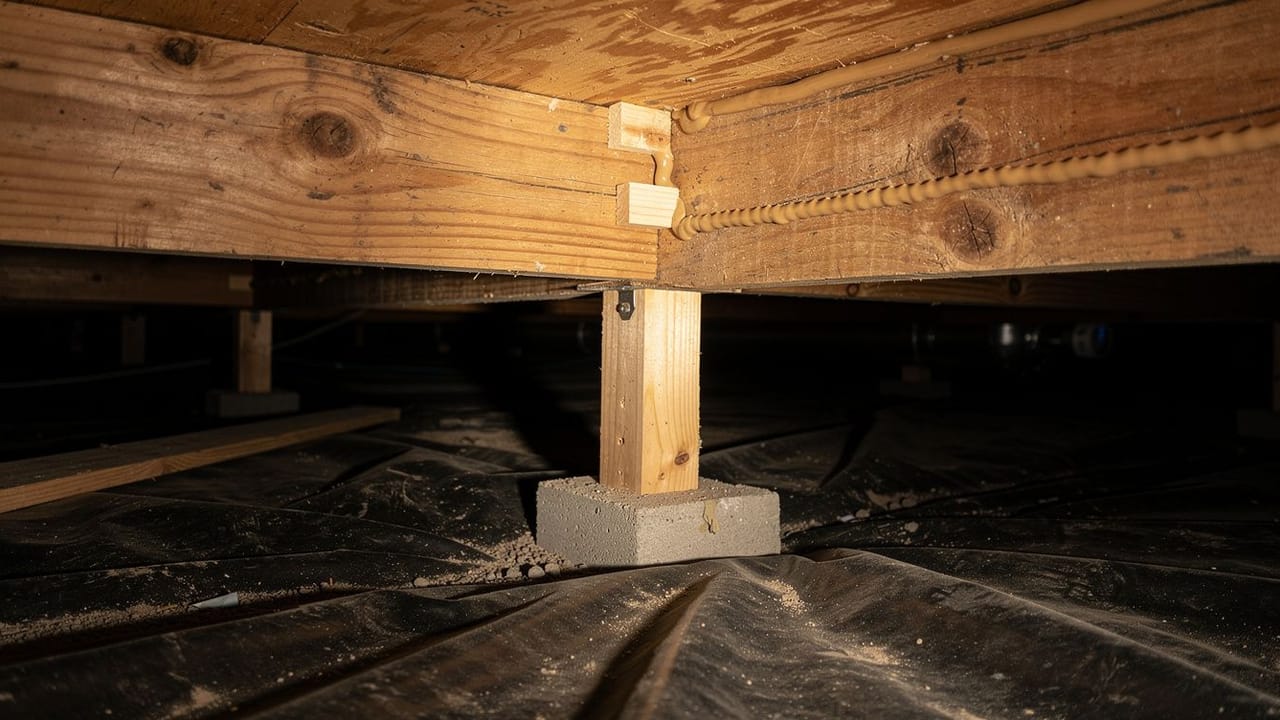
A crawl space or an unfinished basement is the good outcome, because we can reach the problem without touching the finished floor. We tap a shim into the gap between joist and subfloor with construction adhesive, or fit a bracket that draws the two back together. That is the bulk of our subfloor and squeak repair work.
One of us walks the floor above while the other watches from underneath. The movement usually shows from below, which puts the shim exactly where it is needed instead of where we guess it might be.
- Find the movement with someone walking above
- Shim with construction adhesive, and never force the shim in
- Use a bracket where the gap is wider
- Add blocking where joists are moving sideways
- Fasten with screws rather than more nails
How hard is it to fix a squeak from above?
Harder, because anything we do has to pass through the finished surface. Under carpet we use screws made to snap off below the surface. On hardwood the same screw leaves a small hole to fill, so we weigh that against how the floor looks before we use it.
Some homeowners try a dry lubricant such as powdered graphite or talc worked into the seam between two boards. It does nothing for the fastening underneath, so if the noise comes back we go below. Where boards are damaged rather than just noisy, our post on hardwood floor repair without refinishing every room covers the next step.
When is a squeaky floor a sign of something worse?
A squeak that turns up suddenly over a wide area, or that comes with bounce or a slope you can see, is one we take seriously. We go under the house and look at the joists, the posts and how wet the wood is. The Wood Handbook says decay generally needs wood at or above fiber saturation, usually about 30 percent moisture, that a 20 percent reading is sometimes used in field inspections as the most allowed, and that structural failures from decay are rare but have occurred.
Wood over a crawl space can run wetter than the rest of the house, according to the Forest Products Laboratory, and the EPA’s mold course lists humid crawl spaces among the common sites of hidden mold growth and warns that mold left feeding on wet wood can weaken floors. A squeak that persists alongside bounce or sag is worth having the framing checked, so ask us for a free estimate and we will look underneath.
Sources
- USDA Forest Service, Forest Products Laboratory, Wood Handbook (FPL-GTR-282), Chapter 4: Moisture Relations and Physical Properties of Wood — Wood swells as it gains moisture and shrinks as it loses it
- USDA Forest Service, Forest Products Laboratory, Wood Handbook (FPL-GTR-282), Chapter 13: Drying and Control of Moisture Content and Dimensional Changes — Flooring that shrinks when the building is heated can crack; wood over a crawl space can run above normal moisture content; seasonal movement
- USDA Forest Service, Forest Products Laboratory, Wood Handbook (FPL-GTR-282), Chapter 17: Use of Wood in Buildings and Bridges — Subflooring laid over floor framing; decay needs about 30 percent moisture; 20 percent field inspection limit; decay failures rare but have occurred
- US EPA, Mold Course Chapter 2: Why and Where Mold Grows — Humid crawl spaces are common sites of hidden mold growth; mold feeding on wet wood can weaken floors
FAQ
What Makes a Floor Squeak, and How to Stop It — questions
Are squeaky floors a structural problem?
A squeak on its own usually is not. It tends to be loose fastening between the layers of the floor, a nuisance rather than a defect. What we look into is a squeak that comes with noticeable bounce or a slope, or one that appeared suddenly over a wide area, because those are reasons to check the framing and the moisture under the floor.
Will squeaks go away on their own?
Some come and go with the seasons rather than going away. Wood shrinks as it dries out and swells as it takes moisture back, so a floor that squeaks during a heated winter can go quiet in a humid summer. That pattern on its own is not a worry; a squeak that persists year-round and gets worse is the one to address.
Can squeaks be fixed without pulling up the floor?
Usually. With access from below, shims and brackets fix it without touching the finished floor. From above, screws made to snap off below the surface work under carpet, and on hardwood they leave a small hole to fill. Pulling up the finished floor is seldom where we start.
What causes squeaky floors?
Two parts of the floor rubbing that should be fastened tight. Most often the subfloor has lifted off a joist and a nail rubs in its hole underfoot. Floorboards that have loosened against one another, often during a dry heated winter, and a loose piece of bridging or blocking between joists are the other usual culprits.