
· by Michael Blair, Nashville's Flooring
Flooring marketed as pet-friendly is usually being sold on scratch resistance alone. A dog puts four different demands on a floor, and a product that handles one of them beautifully can fail badly on another. Sorting them out first makes the showroom conversation much shorter.
The four problems, separately
Scratching from claws, which is a surface-wear question. Moisture from accidents and wet paws, which is a substrate question. Traction, because a dog that cannot get a grip on a slick floor slides on every turn and scrambles on every start. And noise, because claws on a hard floor in an open plan is a sound you cannot unhear.
No single material wins all four. Hardwood scratches, and water is its weak point: the USDA Forest Products Laboratory’s Wood Handbook explains that wood swells as it gains moisture and shrinks as it loses it, so a puddle left standing on a wood floor is the first thing to clean up. Tile trades those problems for others, since it is hard and cold underfoot, claws click on it, and a glazed surface can be slick under a running dog. The choice is about which of the four you actually care about in your house.
Does a higher Janka rating mean fewer scratches?
The Janka rating is a dent test. The Wood Handbook defines hardness as resistance to indentation, measured by the load it takes to press a 0.444-inch ball halfway into the wood, so it does tell you how a species takes a dropped pan. It measures indentation, not scratching, and a claw mark is a scratch.
So when a dog owner asks us about scratches, we talk about the finish and the sheen before the species, and we would rather you take a sample home and see how it looks after a week with your own dog than trust a number on the box. The solid and engineered floors we put down are on our hardwood installation page. If a salesperson answers a scratch question with a Janka number, they are answering a different question than the one you asked.
What flooring works best with dogs?
Luxury vinyl plank is usually where the conversation starts. When we compare samples for a house with a dog, the figure we look for on the spec sheet is the wear layer, the clear top layer, rather than the overall plank thickness, and we compare products on that. The styles we install are on our luxury vinyl plank page. Whether a plank sold as waterproof will hold up to a dog that has accidents depends on what the label actually covers, which is the subject of our post on what a waterproof flooring label means.
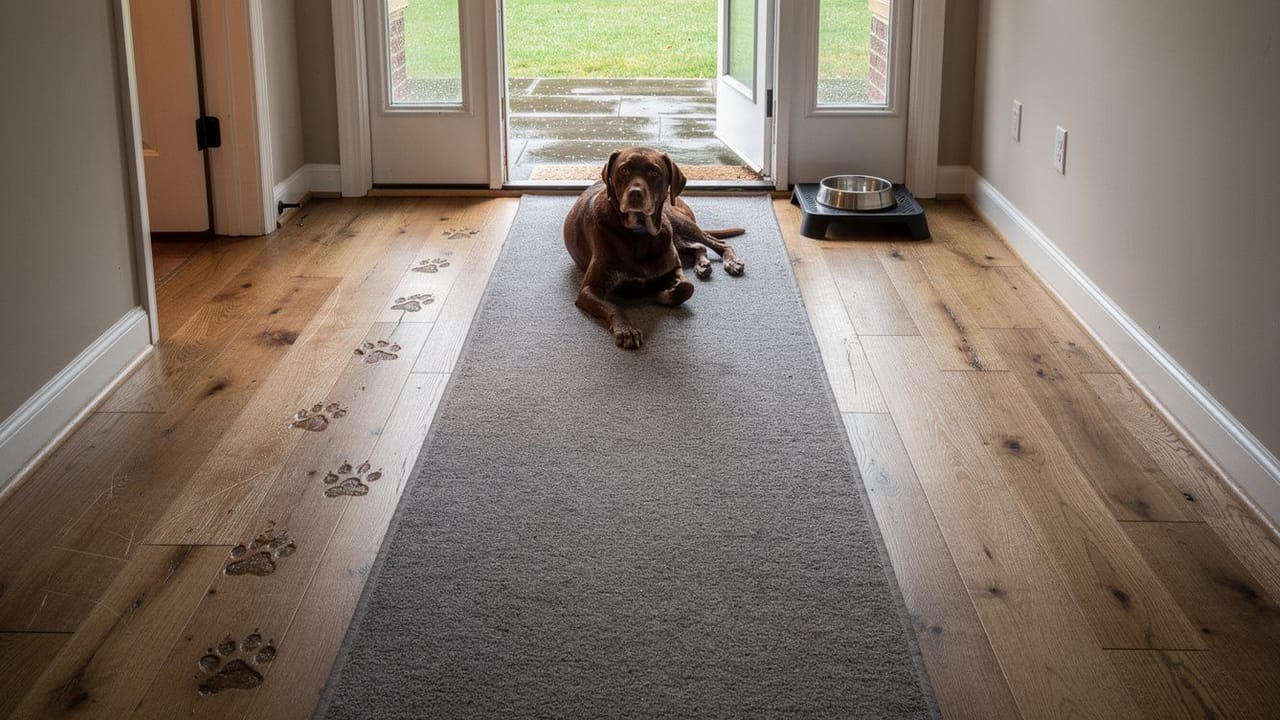
Where a dog comes in muddy, tile is worth a look, as long as you ask about slip resistance before you pick the color. For engineered hardwood, set a matte, wire-brushed or hand-scraped sample beside a high-gloss one and decide which you could live with after a year of claws. Where traction is the worry, a runner along the dog’s main route is the simple fix to try first, though the pad under it needs choosing with care, as our post on rug pads and mats that quietly damage floors explains.
- Vinyl plank: ask for the wear layer figure, not the overall thickness
- Hardwood: Janka hardness is about dents, not scratches
- Compare matte and gloss samples side by side before choosing
- Tile: ask about slip resistance, not just the look
- Runners on the dog’s main routes, on a pad that suits the floor underneath
The Nashville-specific part
Wood floors move with the moisture in the air. The Wood Handbook notes that flooring is dried to the moisture content it will see in service so that shrinking and swelling stay small and the boards neither buckle nor open large gaps, which keeps the seasonal movement small without stopping it; our post on why hardwood floors gap every winter covers what that looks like in a house here. In a house with a dog, an accident that finds one of those gaps is harder to deal with than one sitting on top, which is why we ask about the dog before we talk about seams.
Then there is what sits under the house. If yours stands over a crawl space, moisture can reach the floor from below as well as from the dog. The Wood Handbook says wood installed over a crawl space may run wetter than the usual range, and the EPA’s moisture control guidance for buildings says a damp crawl space may add as much water vapor to the air in a day as all the other sources inside the house combined. The Handbook’s answer to the soil underneath is a barrier such as polyethylene laid on the ground, so we look under the house as well as at the room, and anything wrong with the framing and boards beneath is covered on our subfloor and repairs page. When you are ready, ask us for a free estimate and tell us about the dog.
Sources
- USDA Forest Products Laboratory, Wood Handbook: Wood as an Engineering Material (FPL-GTR-282, 2021) — Hardness as resistance to indentation (Janka ball test); wood swells and shrinks with moisture; flooring dried to in-service moisture content to limit gaps and buckling; wood over a crawl space may run wetter; polyethylene barrier on crawl space soil
- U.S. EPA, Moisture Control Guidance for Building Design, Construction and Maintenance (2013) — Damp crawl spaces may add as much water vapor in a day as all other internal sources combined; wood floor warped by moisture beneath
FAQ
Choosing Flooring When You Have Dogs — questions
Does luxury vinyl plank scratch from dog claws?
It can. When claws are the worry, the figure we ask for on the spec sheet is the wear layer, which is listed separately from the overall plank thickness, and we compare products on that number rather than on how thick the plank feels in the hand.
Can hardwood be refinished after a dog has scratched it?
Solid hardwood usually can, and sanding and refinishing scratched floors is work we do. Engineered hardwood varies from product to product, so if refinishing is part of the plan, ask the manufacturer for the veneer thickness and whether the floor can be sanded before you buy it.
What flooring is best for dog accidents?
Wood is the one to be careful with, because it swells as it takes on moisture, and water that gets underneath can warp the boards from below. Tile and vinyl plank are the usual choices where accidents are likely, but check exactly what a waterproof claim covers, seams included, before you count on it.
Are hardwood floors bad for dogs?
They can work, though hardwood asks for more care with a dog than plank or tile does. It scratches, and water left standing makes the boards swell. Finish and sheen matter more than species, so compare a matte or wire-brushed sample with a glossy one, and lay a runner along the dog’s usual route for grip.