
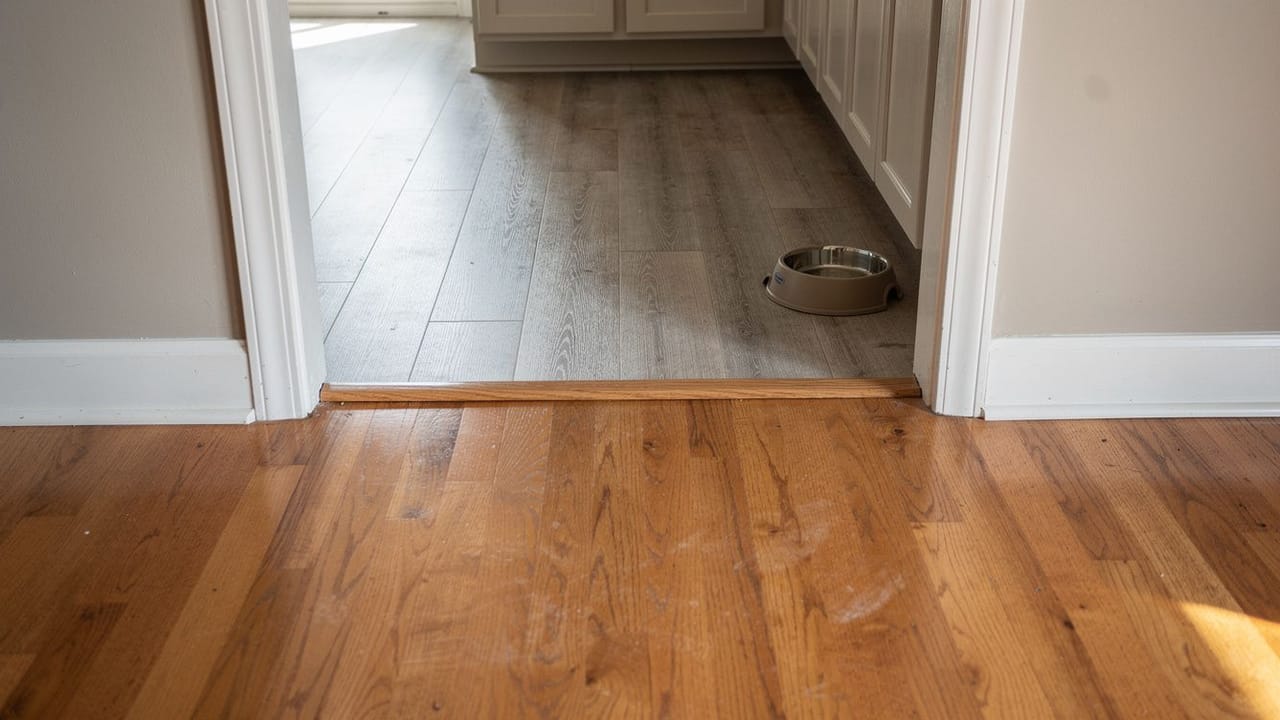
· by Michael Blair, Nashville's Flooring
We install a lot of luxury vinyl plank, and it has come far enough that the old dismissals of vinyl don’t hold. On our jobs it copes with water, dogs and basements better than wood does. What it can’t do is be sanded back to fresh material, and in some parts of the Nashville market that counts when the house sells. This is how we decide between luxury vinyl plank and hardwood room by room.
Where does LVP beat hardwood?
Water, first. The plank itself comes through a wet floor well, so a burst supply line or a dishwasher leak is something an LVP floor can usually survive, provided the water is cleaned up and the subfloor under it is dried out fast. The clock that matters is the subfloor’s: EPA’s guide to mold, moisture and your home says wet or damp materials dried within 24 to 48 hours of a leak in most cases won’t grow mold. That’s why we put it in kitchens, bathrooms, laundries and basements.
Most of the plank we lay is click-lock that floats over the existing subfloor, with no nails or glue, so the install is simpler than nailing down solid boards. It feels warmer underfoot than tile, and with pets in the house it has held up to claws better than the finished wood floors we see, which we go into in our post on flooring with dogs.
Where does hardwood beat LVP?
Wood can be sanded and refinished. When a hardwood floor is worn but sound, we can usually take it back to bare wood and put a new finish on it, and how many more times that’s possible depends on how much wood is left above the tongue, which we check before quoting any refinishing job. A vinyl plank that wears through has nothing under the wear layer to sand back to, so it gets replaced.
Resale is harder to pin down, and this is our impression from working in older Nashville houses, not something we’ve seen measured. In established neighborhoods where period homes are prized, original or solid hardwood tends to be treated as a feature of the listing, and vinyl in the main rooms tends not to be.
- LVP: kitchens, baths, laundries, basements, rentals, pets
- Hardwood: main living areas in period homes, long ownership
- Engineered wood: the middle path over slab or crawl
- Tile: wet areas where cost and warmth are not the priority
Subfloor decides more than people expect
A floating plank is thin and isn’t fastened down, so it follows the shape of whatever it sits on. Over dips and high spots it can flex and click underfoot, and that’s the complaint we hear about LVP more than any other. On concrete, ASTM F710, the standard practice for preparing concrete floors for resilient flooring, says cracks, grooves, depressions and other irregularities should be filled or smoothed with patching or underlayment compound. The same practice says it doesn’t override the flooring maker’s written instructions, and those instructions set how flat a given plank needs the floor to be.
So we price leveling into the job from the start. If two quotes differ and only one includes leveling compound, that one is often the honest number. Wood-framed floors get the same treatment, and we fix squeaks and low spots in the subfloor before any new floor goes over them.
The Nashville slab question
We don’t fasten solid hardwood straight to a concrete slab. When someone wants wood on slab, we steer them to engineered wood or LVP, or to a built wood subfloor over the concrete, and the slab gets a moisture test before any of it. ASTM F2170, the test for relative humidity inside a concrete slab, notes that flooring manufacturers generally require moisture testing before installation on concrete, and names what too much moisture can do once the floor is down: debonding, peaking, deterioration of the finish flooring and microbial growth.
Timing matters too. ASTM F1869, the calcium chloride test for moisture vapor emission, says every concrete subfloor gives off some moisture as vapor and that environmental conditions drive how much. F2170 adds that a result describes the slab only at the time of the test and in the spots tested. We test close to the install date for that reason, because a floor laid over a slab nobody checked can look fine at first and fail months later. Our post on flooring over a concrete slab walks through both tests, and if you’re weighing the two floors for a particular room, ask us for a free estimate and we’ll start with what’s underneath.
Sources
- U.S. EPA, A Brief Guide to Mold, Moisture, and Your Home — Wet or damp materials dried within 24 to 48 hours of a leak or spill will in most cases not grow mold; mold needs water or moisture to grow
- ASTM F710-19, Standard Practice for Preparing Concrete Floors to Receive Resilient Flooring — Cracks, grooves, depressions and other irregularities filled or smoothed with patching or underlayment compound; does not supersede the flooring maker’s written instructions
- ASTM F2170-19, Relative Humidity in Concrete Floor Slabs Using in situ Probes — Manufacturers generally require moisture testing before installing over concrete; excess slab moisture causes debonding, peaking, deterioration and microbial growth; results hold only for the time and spots tested
- ASTM F1869-16a, Moisture Vapor Emission Rate of Concrete Subfloor Using Anhydrous Calcium Chloride — All concrete subfloors emit some moisture as vapor; emission is driven by environmental conditions
FAQ
Luxury Vinyl Plank or Hardwood in Nashville — questions
Does LVP hurt resale value?
We have not seen a study that measures it for Nashville, so this is our impression. In kitchens, bathrooms and basements we rarely hear of good LVP counting against a house. Where it seems to matter is in older homes and at higher price points, where buyers often expect wood in the main living areas and may see vinyl there as a step down.
Is waterproof flooring really waterproof?
The vinyl plank is. The floor as a whole is another matter, because water that gets in at the joints or around the edges can reach the subfloor, where nobody sees it. The EPA says wet materials dried within 24 to 48 hours of a leak usually will not grow mold, so a leak under any floor needs to be found and dried quickly, whatever the box says.
Can LVP go over existing tile?
Often, if the tile is sound, well bonded and flat. We fill the grout lines first to whatever the plank maker’s instructions call for, so they do not show through as lines in the new floor. Loose, cracked or hollow-sounding tile has to come up. When the tile can stay, it saves a tear-out.
Which is better, LVP or engineered hardwood?
It depends on the room. We put LVP where water, pets and basements are the concern, and in rentals. Engineered wood is our middle path where someone wants real wood over a slab or a crawl space, which is also where we steer anyone hoping to fasten solid hardwood to concrete, after a moisture test.